A sagging farm building on family land in Poplar Branch, a 1970s mobile home that has outlived two owners, a storm-damaged cottage near the beach that is not worth repairing — Currituck County has no shortage of structures that need to come down before anything new can go up. Albetuck Land Development works as a demolition contractor across Jarvisburg, Grandy, Powells Point, and the surrounding communities, taking down houses, mobile homes, barns, sheds, garages, slabs, and pools, then hauling the debris and leaving graded, usable ground behind. We handle the disconnects, the permit coordination, and the disposal, so you get a clean lot instead of a pile and a problem. Call (252) 435-4321 for a free estimate.
What Demolition Actually Involves
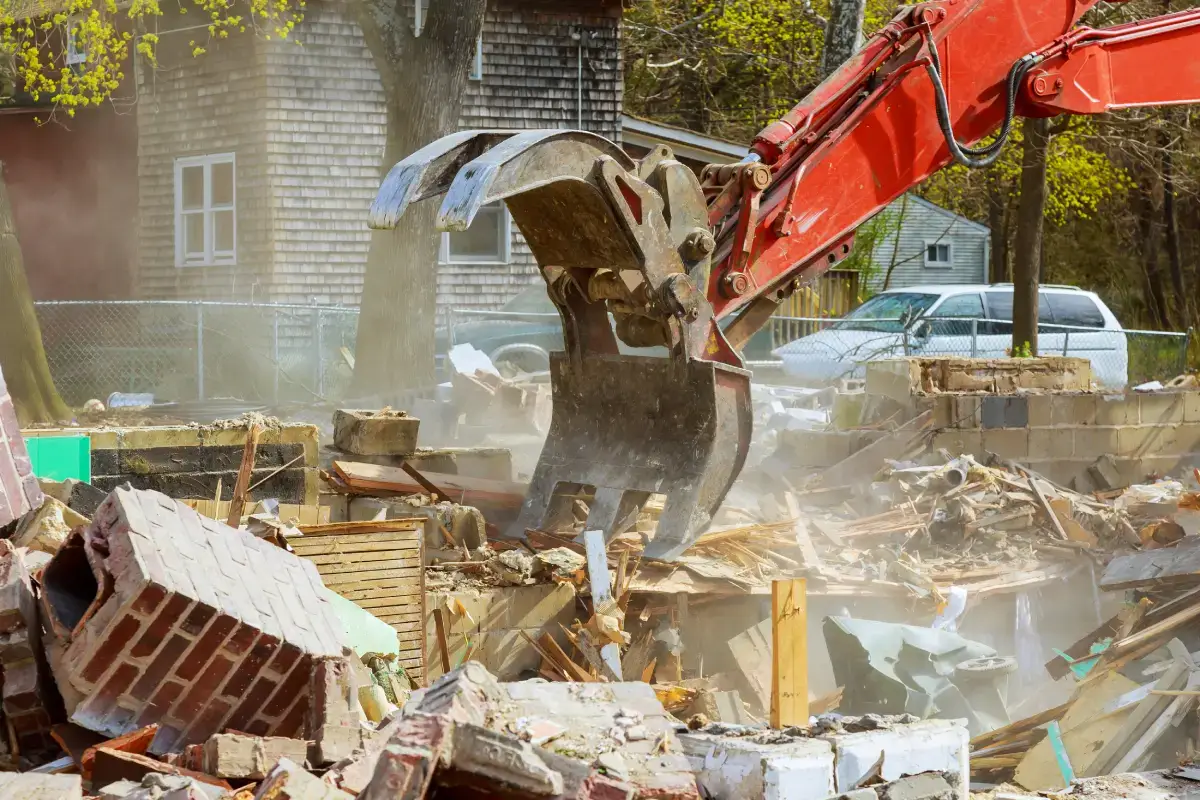
Demolition is a controlled sequence, and the work that matters most happens before a machine touches the building. It starts with a walkthrough to identify the structure type, its construction, what is attached to it, and what is inside it. Utilities have to be formally disconnected and capped — power pulled by the utility, water shut and capped, gas disconnected, and any existing septic tank properly abandoned rather than simply buried. Older buildings require an asbestos inspection, because siding, floor tile, mastic, roofing, and pipe insulation from the mid-twentieth century routinely contain it, and North Carolina requires notification to the state’s Health Hazards Control Unit before demolition of covered facilities regardless of whether asbestos was found. Salvage decisions get made next — heart pine, beams, fixtures, or metal roofing sometimes justify pulling before the machine starts. The mechanical work itself is done with an excavator running a hydraulic thumb, grapple, or breaker, working the structure down in sections rather than pushing it over, so material falls inside the footprint and can be sorted as it comes. Concrete, metal, and wood are separated for disposal, because mixed loads cost more at the transfer station than sorted ones. Foundations, slabs, and footings come out; the hole is backfilled with clean material, compacted in lifts, graded, and stabilized. What was a liability on your property becomes a level, seeded, buildable lot — with the paperwork trail to show it was done correctly.
Our Demolition Process
Step 1 — Walk the structure and price the real job. We inspect the building, note its construction and age, check for attached structures, buried tanks, wells, and old septic systems, and look at access for equipment and trucks. Age is the key variable: a 1950s farmhouse and a 2005 outbuilding are entirely different jobs because of what may be in the older one’s materials. We also look at what is next to the structure, since a demo three feet from a neighbor’s fence in Kill Devil Hills is a different operation from one in the middle of a Currituck field.
Step 2 — Disconnects, inspection, and permits. We coordinate utility disconnects with the power, water, and gas providers, arrange the asbestos inspection where the structure’s age or type calls for it, and work with you on the county demolition permit. North Carolina requires notification to the state at least ten working days before demolition of covered commercial, institutional, and industrial facilities, and abatement rules apply to regulated material wherever it is found. Skipping this step is how owners end up with stop-work orders and penalties, and it is not a corner we cut.
Step 3 — Salvage, then take it down in sections. Anything worth saving comes out first. Then our operator works the structure down methodically with an excavator and thumb, collapsing it into its own footprint rather than pushing it outward, keeping dust down with water where conditions call for it. Material is separated as it falls — concrete and masonry in one pile, metal in another, wood and general debris in a third. Sorting during demolition rather than after is faster, safer, and cheaper at the landfill.
Step 4 — Foundations, slabs, and underground. Slabs, footings, and foundation walls get broken out and removed. Old septic tanks are pumped and properly abandoned rather than left to collapse under a future driveway. Buried fuel tanks, wells, and old cisterns are dealt with according to their own rules. This is the step most often skipped by the cheapest bid on a demo job, and it is the one that surfaces years later when someone tries to build on the spot.
Step 5 — Backfill, grade, and stabilize. We haul the debris to the proper facility, backfill the excavation with clean fill in compacted lifts so the ground does not sink, grade the area to shed water, and stabilize the disturbed soil. You are left with a level, clean, buildable site and a property that no longer carries an insurance liability or a code complaint on it.
Serving Jarvisburg and the Surrounding Area
Albetuck Land Development runs demolition work throughout Currituck County — Jarvisburg, Grandy, Poplar Branch, Aydlett, Powells Point, Harbinger, Point Harbor, Coinjock, Barco, Maple, Currituck, Shawboro, and Moyock — and out across the Wright Memorial Bridge to Southern Shores, Duck, Kitty Hawk, Kill Devil Hills, Nags Head, and Corolla. We also work Elizabeth City, Manteo, Columbia, and the Hatteras Island villages down NC-12.
The demolition work in this region has its own character. Mainland Currituck has a large stock of older farm buildings, tobacco and equipment barns, and manufactured homes from the 1970s and 1980s, all of which need asbestos consideration and careful disposal. The barrier island communities have aging rental cottages on tight lots where neighboring structures sit close, access is restricted, and the working window is dictated by the rental season. And after any significant nor’easter or hurricane season, both sides of the sound generate storm-damaged structures that need to come down quickly and correctly. We plan around all three.
Why Property Owners Here Choose Albetuck
We are a local family operation, not a crew that shows up from three counties over, quotes low, and leaves the foundation in the ground. Clay Newbern grew up in this business on his father’s crews and has worked this county his whole life. Our team of six to seven means the same people are on your property from start to finish. Read more about who we are.
The two things that separate a proper demolition from a cheap one are what happens to the material and what happens underground. On the material side, North Carolina’s asbestos requirements are administered by the N.C. Health Hazards Control Unit, which requires notification ten working days ahead for covered demolitions and permits for regulated asbestos removal above set thresholds. On the permitting side, Currituck County Planning and Inspections at the Historic Courthouse issues the local demolition permit and inspections. We work within both, and we document what we did.
Because we also clear land, haul material, and grade, a demolition here can roll straight into site preparation for whatever comes next without a gap between contractors.