There is a version of land clearing that produces no burn pile, no dump truck traffic, and no field full of stump craters. Forestry mulching grinds standing brush and small trees into a mulch layer right where they stand, and on the flat, sandy, seasonally wet ground between Jarvisburg and Currituck Sound it is often the smarter first move. Albetuck Land Development mulches overgrown lots, fence lines, trail routes, hunting lanes, farm edges, and neglected acreage across Currituck County and out to the Outer Banks. One machine, one pass, one crew — and the material stays on your property working as erosion cover instead of leaving on a truck you paid for. Call (252) 435-4321 for a free estimate on your acreage.
What Forestry Mulching Actually Involves
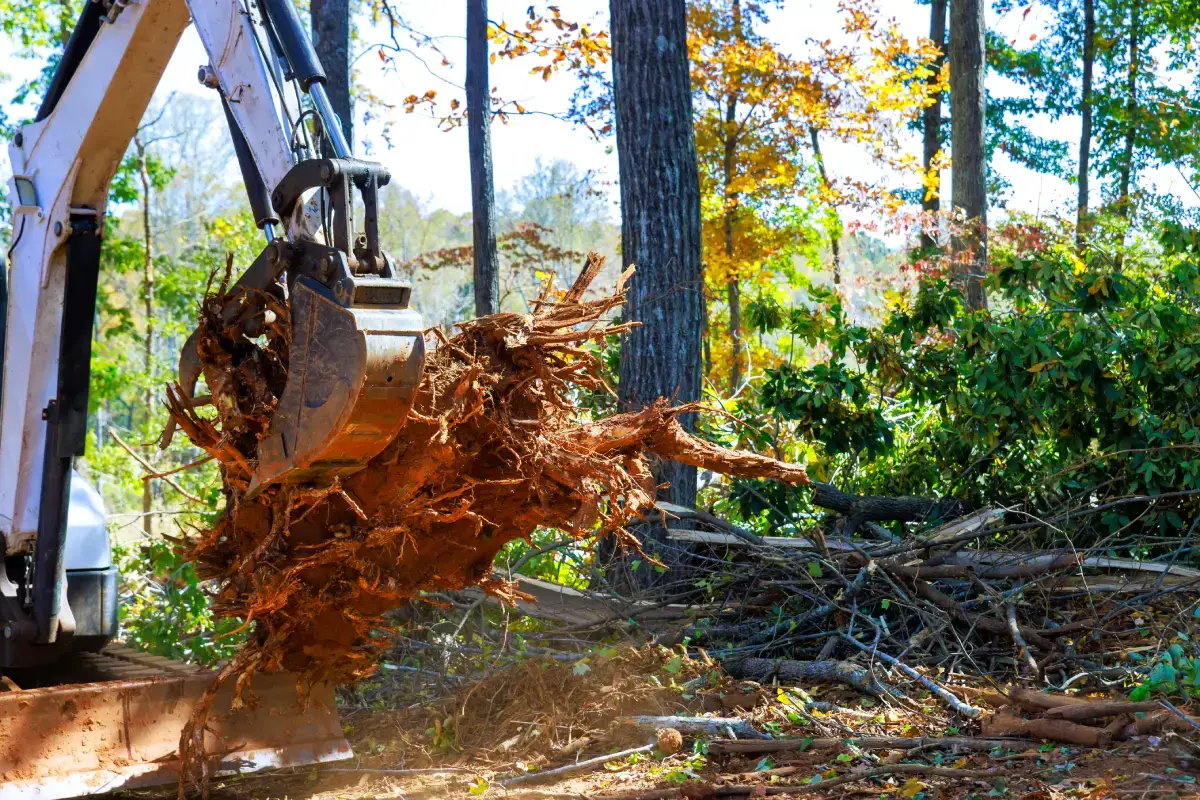
Forestry mulching is mechanical clearing that reduces standing vegetation to mulch in place, in a single operation, without a separate cut, pile, and haul cycle. The work is done by a drum mulcher head — a steel drum fitted with carbide or fixed-tooth cutters spinning at high speed — mounted on a compact track loader or an excavator arm. The operator works the head from the top of a stem downward, shaving the material into chips that fall to the ground rather than felling it whole. A typical head handles standing stems up to roughly six to eight inches in diameter; anything larger is generally felled with a chainsaw first, then processed. The result is a mulch mat two to four inches deep across the worked area. Because nothing is uprooted, the root systems stay in the ground holding the soil together, which matters on sandy Currituck ground that erodes readily once it is bare. That mat suppresses regrowth for a season or more, breaks down into organic matter, and does not need a burn permit, a dump truck, or a disposal fee. What it does not do is produce a building site: stumps remain at or just below grade, so if the ground is going to carry a slab, a pad, or a drainfield, mulching is the first step and not the last one. Most owners walk a property that was an impenetrable thicket in the morning and see open, walkable ground with standing timber by the afternoon.
Our Forestry Mulching Process
Step 1 — Walk the acreage and agree on what stays. Mulching is selective by nature, which is its biggest advantage and the thing most owners do not realize they can ask for. We walk the tract with you and mark the mature trees, hardwoods, or shaded areas you want preserved. We also identify wet spots, ditch banks, old fence wire, buried debris, and stumps that could damage a cutting head. That walk sets the scope and the day rate honestly.
Step 2 — Match the machine to the ground. A compact track loader with a drum mulcher is the workhorse for most residential and small-acreage jobs, and its low ground pressure lets us work soft mainland ground without leaving ruts a tractor would. Where stems are heavier or the terrain is uneven, we run an excavator-mounted head instead, which gives reach over ditches and lets the operator work from firmer ground. Choosing correctly on the front end is the difference between a clean job and a torn-up field.
Step 3 — Mulch in passes, to the finish you asked for. A single pass knocks vegetation down and leaves a coarser mat; additional passes produce finer mulch and a cleaner look, at more machine time. We agree on which one you want before we start, because a hunting lane and a future homesite lawn are not the same finish. Our operator works methodically across the tract rather than skipping around, so the coverage is even and nothing gets missed under fallen material.
Step 4 — Grade the mat and walk the property with you. We spread the mulch evenly rather than leaving windrows, knock down high stumps that would be a trip or tire hazard, and clear any wire, metal, or trash we turned up. Then we walk the finished tract with you before the equipment leaves. You get back land you can see across, walk through, and use — and a mulch layer that holds your soil in place through the next nor’easter instead of a bare field that washes.
Serving Jarvisburg and the Surrounding Area
Albetuck Land Development runs mulching equipment the full length of the Currituck mainland along Caratoke Highway — Grandy, Poplar Branch, Aydlett, Waterlily, Powells Point, Harbinger, and Point Harbor to the south, and Coinjock, Barco, Maple, Currituck, Shawboro, and Moyock to the north. We cross into Southern Shores, Duck, Kitty Hawk, Kill Devil Hills, Nags Head, and Corolla, and run west to Elizabeth City and south to Manteo, Columbia, and the Hatteras Island villages.
Mulching suits this region for a specific reason. Currituck is one of eighteen North Carolina counties classified as high-hazard for forest fire, and any ground clearing operation that piles or windrows debris across more than five contiguous acres needs a special burn permit issued only by the county ranger — assuming the wind, the setbacks, and the air quality forecast all cooperate on the day you want to light it. Mulching sidesteps that entirely. On top of that, the mat left behind is genuine erosion cover, which is worth real money on the loose sandy soils common from Powells Point out to the beach, and on flat mainland ground where the water table sits high enough that hauling debris off in the wet months would tear the field apart.
Why Property Owners Here Choose Albetuck for Mulching
This is a family trade for us. Clay Newbern grew up on his father’s land clearing and sitework crews in this county and has been working this ground his whole life, which shows up in the details — knowing which fields hold water into April, which lanes a low-boy can actually get down, and which lots on the banks will not tolerate a wheeled machine. You can read more about our team and how we work before you call.
We are also straight with customers about when mulching is the wrong tool. If you need buildable ground, mulching alone will not get you there and we will say so at the estimate rather than after the invoice. And when a tract crosses one acre of actual soil disturbance, an approved erosion and sediment control plan is required under the state’s Sedimentation Pollution Control Act and must be filed 30 days ahead — one of the reasons mulching, which leaves root systems and ground cover intact, is frequently the lower-friction path on sensitive sites.
Estimates are free, we work 8 to 5 Monday through Saturday, and mid-summer is historically our lighter season — which usually means faster scheduling if your project can wait for the heat.