A wooded acre off Caratoke Highway can go from open ground to impassable thicket in three or four growing seasons. Eastern North Carolina’s long, wet summers push greenbrier, wax myrtle, loblolly pine, and sweetgum hard, and by the time most owners call about land clearing services, the lot they walked before closing no longer shows its own property corners. Albetuck Land Development clears building sites, farm ground, driveway routes, and neglected acreage throughout Jarvisburg, Grandy, Powells Point, and the rest of Currituck County — brush only, or down to bare dirt with the stumps pulled, depending on what the next stage of your project actually requires. We pull the burn permits, deal with the debris, and leave the site graded to drain. Call (252) 435-4321 for a free estimate.
What Land Clearing Actually Involves
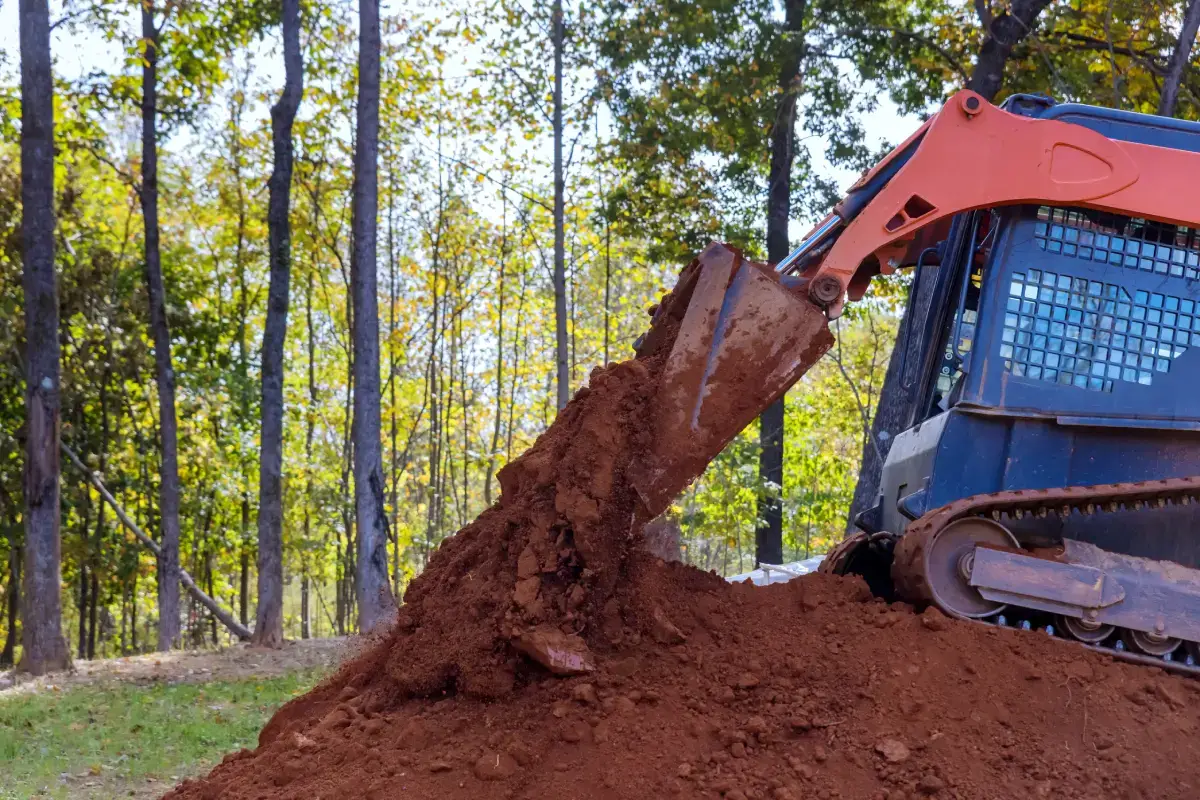
Land clearing is the removal of standing vegetation, root systems, and surface debris from a parcel so it can be built on, farmed, fenced, or simply used again. The work runs in a set sequence. We start by walking the tract with you and flagging the limits of clearing, keeping the trees you want to keep and confirming property lines, easements, and any wetland or ditch buffers that need to stay untouched. From there, a tracked dozer with a root rake or an excavator running a grapple and hydraulic thumb takes the standing material down, and the same machines grub out root balls and stumps rather than shearing them at grade — a sheared stump will send up shoots within a season and will not support a slab or a compacted pad. Debris is windrowed and separated: burnable plant growth in one pile, root balls and dirt-heavy material in another, and anything non-vegetative staged for hauling, since state rules do not allow it in a burn pile. Once the material is gone, we backfill stump holes with clean fill, rough grade the tract so water moves off it, and stabilize disturbed ground. What you get back is a site that a surveyor, a septic installer, or a framing crew can actually work on — instead of a lot you can only look at from the road.
Our Land Clearing Process
Step 1 — Walk the tract and set the limits of clearing. We meet you on the property, walk the boundaries, and paint or flag exactly what comes out and what stays. This is when we identify ditches, drainage easements, sound-side buffers, and any specimen trees you want protected. We also look at access, because getting a dozer and a tri-axle onto a soft Currituck lot in February is a different problem than getting them on in September.
Step 2 — Handle permits, locates, and erosion control before anything moves. We file the burn permit with the N.C. Forest Service county ranger, submit an NC811 locate request so buried lines are marked, and put erosion control in place where the job calls for it. Currituck is one of North Carolina’s designated high-hazard burn counties, and ground clearing that involves more than five contiguous acres of piled debris requires a special permit that only the county ranger can issue. Getting that filed early is the difference between clearing on schedule and sitting on a burn pile you legally cannot light.
Step 3 — Fell, grub, and separate the material. Our crew drops standing timber and brush, then works back across the tract pulling root balls with a root rake or excavator bucket. Material is separated as it comes out — clean plant growth for burning, dirt-laden root wads for shaking out and hauling, and any old fence wire, tin, or buried trash set aside for proper disposal. Separating on the front end costs a little machine time and saves more than that in disposal fees.
Step 4 — Dispose of the debris the way the site and the rules allow. Depending on volume, proximity to houses and roads, and the air quality forecast, we burn on site under permit, haul off, or mulch material in place. State open burning rules keep land clearing piles at least 500 feet from occupied structures and 250 feet from a public road when the wind is blowing that way, restrict burning to daylight hours, and prohibit it entirely on poor air quality days. On tight lots near Kitty Hawk or Southern Shores, burning usually is not an option at all, and we plan for hauling from the start.
Step 5 — Backfill, rough grade, and stabilize. Stump holes get backfilled with clean material and compacted so the ground does not settle into craters after the first hard rain. We rough grade the cleared area so water sheds toward the ditch or swale instead of ponding, and stabilize disturbed soil where required. You end up with a clean, walkable, workable site — surveyable, stakeable, and ready for the septic evaluation, the pad, or the fence line that comes next.
Serving Jarvisburg and the Surrounding Area
Albetuck Land Development runs out of Jarvisburg on Caratoke Highway, which puts our equipment within a short haul of most of the work in this county. We clear lots and acreage throughout the Currituck mainland — Grandy, Poplar Branch, Aydlett, Powells Point, Harbinger, Point Harbor, Coinjock, Barco, Maple, Moyock, and Shawboro — and cross the Wright Memorial Bridge regularly for jobs in Southern Shores, Duck, Kitty Hawk, Kill Devil Hills, Nags Head, and Corolla. We also work west toward Elizabeth City and south through Manteo, Columbia, and down NC-12 to Rodanthe, Salvo, Avon, Buxton, Frisco, and Hatteras.
Ground conditions here change more than the flat terrain suggests. Lower Currituck sits on old agricultural land with almost no fall in it, and near the sound the seasonal water table comes up within a couple of feet of the surface, which means a lot that clears easily in October can rut badly in March. Barrier island lots are the opposite problem — fast-draining sand that will not hold a slope without cover. We schedule and equip around both, running tracked machines on wet ground to keep ground pressure down and timing debris burns around wind direction and the air quality forecast rather than the calendar.
Why Currituck County Property Owners Choose Albetuck Land Development
Clay Newbern has been on land clearing and site work jobs in this county since he was five years old, riding along on his father’s crews at F&H, the family company that did septic, sitework, and clearing across Currituck for decades. Albetuck runs six to seven people, which is small enough that the person who quoted your job is on the site while it is being done and big enough to keep a dozer, an excavator, and trucks moving at the same time. You can meet the crew behind the equipment and see what we have handled.
The part most owners underestimate is the paperwork. Open burning in North Carolina is governed by rules the N.C. Division of Air Quality has enforced since 1971, and burn permits for woodland or near-woodland fires come through the N.C. Forest Service. Currituck’s high-hazard designation adds a layer on top of that. We file those permits as part of the job, not as something we hand back to you at the estimate. Where a tract exceeds one acre of disturbance, we also flag the state erosion and sediment control plan requirement early, because that plan has to be approved before dirt moves.
We quote free estimates, work 8 to 5 Monday through Saturday, and take on jobs from a quarter-acre backyard thicket up to multi-acre development tracts.